Overview
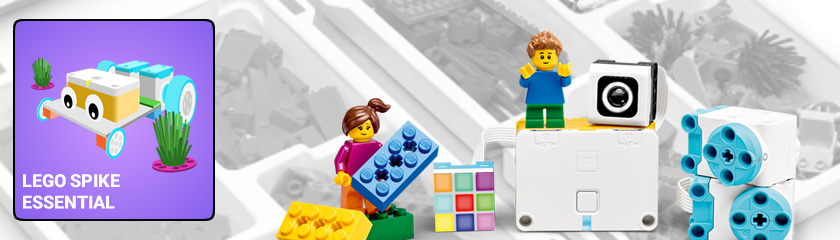
Students work in pairs to build LEGO robots and program them to move, react to colours and complete missions. SPIKE Essential is LEGO's robotics kit for primary school: a small hub, two motors, a colour sensor and a small light display, programmed in the SPIKE app with icon blocks (for younger students) or word blocks (for older students).
Objectives
- Build working models from instructions, then change them to solve a problem (thinking skills).
- Write short programs using sequences, loops and simple decisions, and fix them when they don't work (thinking and self-management skills).
- Measure and predict: how far a robot travels for each turn of its wheels (thinking skills, with mathematics).
- Work in a pair with shared roles, builder and programmer, swapping each lesson (social skills), and explain the robot to others (communication skills).
Scheme of work
This ten-lesson outline is tentative. The order and pace of lessons will be adjusted to the students' ages, experience and interests.
| Lesson | Focus | Students build or do | ATL skill |
|---|---|---|---|
| 1 | Meet SPIKE | Unpack the kit, connect the hub, make a motor spin | Self-management: caring for equipment |
| 2 | Sequences | Program a model to move in a set order of steps | Thinking: putting steps in order |
| 3 | Loops and timing | Make a fan or a dancing robot repeat a pattern | Thinking: spotting patterns |
| 4 | The colour sensor | Program the robot to react differently to each colour | Research: testing and observing |
| 5 | Light and sound | Use the light display and sounds to give feedback | Communication: signals and messages |
| 6 | Decisions | "If it sees red, stop; if it sees green, go" | Thinking: cause and effect |
| 7 | A driving base | Build a car; measure how far one wheel turn takes it | Thinking: measuring and predicting |
| 8 | Mission challenge | Solve simple field missions in competition style | Social: working as a pair |
| 9 | Team mission | Design, build and test a mission of the pair's own | Self-management: planning and testing |
| 10 | Robot showcase | Families watch robots complete missions; pairs explain how theirs works | Communication: presenting |
Lesson structure (60 minutes)
| Minutes | Stage | What happens |
|---|---|---|
| 5 | Warm-up and kits out | Kits handed out and checked; a quick question about last week |
| 10 | New idea | One new idea, shown with a working model |
| 35 | Build and test | Pairs build, program, test and improve |
| 10 | Share and pack up | Two or three pairs show their robot; parts checklist and pack-up |
Mixed grades: levels A, B and C
The class shares one core task each lesson, with harder endings:
- Level A: follow the build and the program shown. Usually Grades 1–2, with icon blocks.
- Level B: change the program to do something new. Usually Grades 3–4, with word blocks.
- Level C: invent a new model or mission. Usually Grade 5.
Pairs are matched by level so that both students do real work.
Potential competitions
Singapore's National Robotics Competition has a Lower Primary category (ages 7–9) for SPIKE Essential robots, with teams of two or three and a coach. Registration usually closes in early July and the competition runs in August. Interested students could form a team after the course.
Requirements
- Kits: school SPIKE Essential kits, one per pair of students.
- Devices: one device with the SPIKE app per kit. Grades 1–3 need school iPads or laptops; Grades 4–5 can use their own iPads.
- Room: the STEM Room (L4), with table space for building.
Expected outcomes
By the end of the course, each pair will have built and programmed several robots and completed a mission of their own design. Students should be able to explain, in their own words, how a sequence, a loop and a decision make their robot behave. The course builds confidence with building and coding. It doesn't assume any previous experience.
Curriculum and resources
- Fundamentals of Coding with SPIKE Essential Carnegie Mellon Robotics Academy's free primary-school curriculum
- LEGO Education teacher resources: SPIKE Essential Lesson units for lower and upper primary